If you’re building or upgrading a WordPress website, the free version of Elementor will get you a long way. But once you want full control over headers and footers, a working popup, or proper WooCommerce design tools, you’ll hit the point where Elementor Pro becomes the obvious next step. The tricky part in 2026 is that Elementor now offers more plans than ever, including a new all-in-one subscription called Elementor One.
Here’s exactly what each plan costs, what you get for your money, and how to get it onto your site.
What Is Elementor Pro?
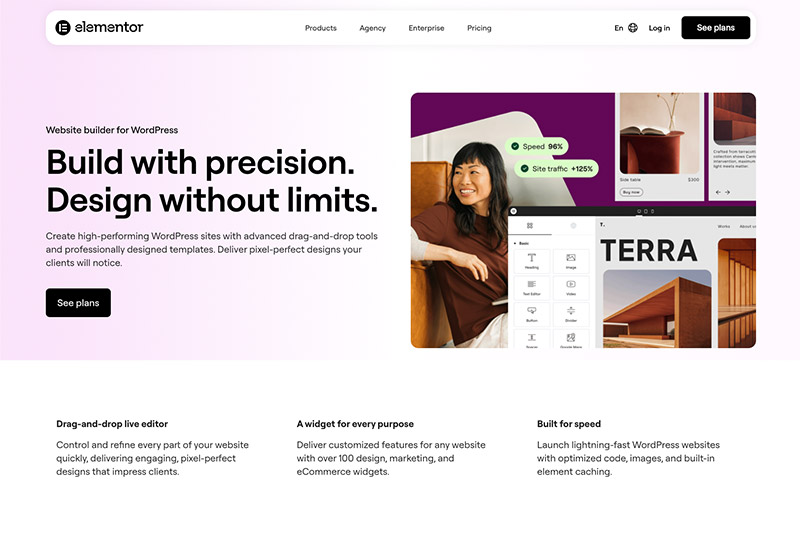
Elementor Pro is the paid extension of Elementor, the page builder plugin used on millions of WordPress sites. The free version lets you build pages visually without touching code. Pro adds the tools that turn a page builder into something closer to a full website builder: a Theme Builder for headers, footers, and archive templates, a Popup Builder, a Form Builder, and (depending on your plan) the WooCommerce Builder for online stores.
Elementor Pro Pricing at a Glance (2026)
| Plan | Annual Price | Sites | Best Suited To |
|---|---|---|---|
| Essential | $59 | 1 | A simple, professional single site |
| Advanced Solo | $84 | 1 | A solo shop or business needing Popups and WooCommerce |
| Advanced | $99 | 3 | Freelancers managing a small handful of sites |
| Elementor One | $228 (launch price $168 for year one) | 1 | Unlimited AI, image optimisation, and accessibility tools in one subscription |
| Expert | $199 | 25 | Agencies and freelancers managing a growing client base |
| Agency | $399 | 1,000 | Larger teams managing many client sites |
These are list prices in US dollars and can change, including during sales periods, so it’s worth checking Elementor’s own pricing page before you buy.
What Do You Actually Get With Elementor Pro?
The Theme Builder
The Theme Builder is what lets you design the parts of a WordPress site that your theme would normally lock away, things like headers, footers, single post templates, and archive pages. It’s the feature most people upgrade for, because it removes the need to dig into theme files or hire a developer for small structural changes.
The WooCommerce Builder
If you’re running an online shop, the WooCommerce Builder lets you design your product pages, cart, and checkout visually rather than relying on whatever your theme gives you by default. It’s worth noting that full WooCommerce customisation sits in the Advanced Solo plan and above, not the entry-level Essential tier.
You might also find this helpful
Popups and Forms
Pro includes a built-in Popup Builder and Form Builder, which between them can replace two or three separate plugins you might otherwise be paying for. You can build lead-capture popups, exit-intent offers, and custom forms without leaving the Elementor editor.
Widgets, in Plain Numbers
Widget counts depend on which plan you’re on rather than being a flat figure across the board. Essential includes 57 Pro widgets on top of the 32 free ones, while Advanced Solo and every plan above it includes 85. That’s the figure to look for if a plan page or comparison table tells you something different, since the exact number has shifted as Elementor’s product range has grown.
What Is Elementor One?
Elementor One is a newer subscription that bundles several things together rather than selling them separately. If you’ve found yourself adding extra plugins or paying for additional AI credits, image optimisation, or accessibility scanning on top of your Pro licence, One is built to cover all of that in a single plan.
It includes:
- Unlimited use of Angie, Elementor’s AI assistant, for generating widgets, custom code, and layouts from a prompt or a screenshot
- Automatic image optimisation, converting images to WebP or AVIF for faster loading
- Accessibility tooling that scans your site for WCAG compliance issues and offers AI-assisted fixes
Do you need Elementor One if you already have Pro? Not necessarily. If you’re happy with your current widget library and don’t lean heavily on AI tools or image optimisation plugins, a standard Pro plan will likely cover what you need. One earns its place if you’re already paying separately for several of these extras and would rather have them under one subscription.
Flexible Containers and the New Way of Building
For a long time, Elementor pages were built from sections and columns, a structure that worked well but added a fair amount of unnecessary code underneath. Flexbox containers replaced that approach, cutting down on extra div wrappers and giving you more direct control over how elements behave across screen sizes.
In practice, this means fewer nested elements, more predictable responsive behaviour, and generally faster-loading pages once you switch over.
Do you need to convert your old sections to containers? Not urgently. Existing sections will keep working, but new pages are worth building with containers from the start, and it’s worth converting key landing pages over time if site speed matters to you (and it usually does).
Elementor Pro vs Elementor Free
| Feature | Free | Pro |
|---|---|---|
| Widgets | 32 | 57 to 85, depending on plan |
| Theme Builder | No | Yes |
| Popup Builder | No | Yes |
| WooCommerce Builder | No | Yes (Advanced Solo and above) |
| Form Builder | No | Yes |
| Custom CSS | No | Yes |
| Support | Community | Plan-dependent |
Can you use Elementor Pro on more than one site? It depends entirely on your plan. Essential and Advanced Solo are limited to a single site, Advanced covers three, Expert covers 25, and Agency covers up to 1,000. If you’re managing client sites, this is usually the deciding factor when choosing between plans rather than the feature list itself.
You might also find this helpful
How to Add Elementor Pro to Your WordPress Website
Once you’ve chosen a plan and made your purchase through Elementor’s official site, getting it onto your site is a short process:
- Log into your Elementor account and download the Elementor Pro zip file.
- In your WordPress dashboard, go to Plugins, then Add New, then Upload Plugin.
- Select the zip file you downloaded and click Install Now.
- Activate the plugin once installation finishes.
- Go to Elementor, then License, and enter the licence key from your Elementor account to unlock Pro features.
That’s the whole process. No FTP access or code editing required, and you’ll see the new Pro widgets and builders appear inside the Elementor editor as soon as the licence is activated.
Choosing the Right Plan for Your Situation
For a single, fairly simple site such as a blog or a small business brochure site, Essential tends to cover what you need. If you’re running a shop or want the Popup Builder alongside your Theme Builder, Advanced Solo is the natural step up. Freelancers juggling a handful of client sites usually find Advanced strikes a reasonable balance between cost and site allowance, while agencies managing a growing roster tend to find Expert or Agency makes more financial sense than buying several smaller licences separately.
Elementor One is worth a look if AI generation, image optimisation, and accessibility tooling are all things you’d otherwise be paying for individually.
Final Thoughts
Elementor Pro’s pricing has become a bit more layered in 2026 with the addition of Elementor One, but the underlying decision hasn’t really changed: work out which features you’ll actually use, then match that to the plan with the right site allowance. For most single-site builds, that’s still Essential or Advanced Solo.
If you’d rather hand the whole build over to someone else, that’s exactly the kind of project our web design team at Suki Marketing takes on day to day. Get in touch through our contact page or book a free call if you’d like a hand working out what your site actually needs.
Disclaimer: This post contains affiliate links. If you purchase through these links, we may receive a small commission at no extra cost to you.