AI matters for SEO because it changes where people get answers and how they find businesses. Google now shows AI-written summaries above many of its results, and more people ask tools like ChatGPT, Gemini and Perplexity for recommendations. SEO still gets you found, but being found now also means being understood and trusted by AI.
If you’ve seen a headline saying SEO is dead, you’re not alone. I get asked about it most weeks. Here’s my honest take on why AI matters for SEO, what has changed, who it affects and what’s worth doing about it, in plain English and without the panic.
Why AI matters for SEO: What has actually changed?
Two things have changed. Google now often puts an AI-written summary, called an AI Overview, at the top of its results. And more people ask AI assistants like ChatGPT for answers and recommendations instead of searching. Both mean your business can be seen, or skipped, before anyone reaches your website.
AI Overviews in Google results
AI Overviews are short summaries Google writes using AI, with links to the websites it drew on. They arrived in the UK in August 2024. Google also has AI Mode, a chat-style search where you can ask follow-up questions and get a longer answer.
People asking ChatGPT, Gemini and Perplexity
People don’t just type a few keywords any more. They describe exactly what they need, for example: “I need a kitchen fitter on the Isle of Wight who can start in spring and won’t charge a fortune.” The AI then suggests a shortlist.
If your business isn’t easy for it to understand, you’re unlikely to make that list.
Fewer clicks for simple questions
In a 2025 study of 900 US adults, Pew Research Center found that people clicked a traditional search result on about 8% of Google visits that showed an AI summary.
Without an AI summary, that figure was about 15%.
It’s a US study, so UK numbers may differ. The direction is clear, though: when Google answers the question itself, fewer people click.
Is SEO dead?
No. SEO isn’t dead, but the job has grown. AI tools still need websites to learn from and link to, and Google says its AI features rely on the same fundamentals as normal search. What has changed is that ranking is no longer the whole story: you also want to be the business AI understands, trusts and mentions.
Think of it like a busy shop. SEO gets you into the shop and onto the shelves. AI is the helpful assistant who walks the customer over to the two or three products it rates. You can’t be recommended if you’re not in the shop.
Google’s own guidance, last updated in December 2025, says there are no extra requirements or special optimisations needed to appear in AI Overviews or AI Mode. The advice is the same as it’s always been: let Google crawl your site, link to your important pages, keep key information in text, and keep your Business Profile up to date.
If you’re weighing up whether SEO is still worth the money, our guide to what SEO costs breaks down what you should actually be paying for.
SEO vs GEO: is it a whole new thing?
GEO stands for generative engine optimisation: making your business easy for AI tools to find, understand and mention. It overlaps heavily with SEO. Most of the work is the same. What changes is where you might appear (inside AI answers as well as search results) and how you measure success.
| Traditional SEO | GEO | |
|---|---|---|
| Where you show up | Google and Bing search results | AI Overviews, AI Mode, ChatGPT, Gemini, Perplexity |
| What success looks like | Rankings, clicks and enquiries | Mentions, citations and enquiries |
| The groundwork | A crawlable site, useful content, links and reviews | The same, plus consistent information about your business across the web |
You’ll also hear AEO (answer engine optimisation). Same idea, different acronym. I wouldn’t lose sleep over the labels.
Which businesses are most affected?
Businesses that rely on traffic from simple questions are the most exposed, because AI can answer those without a click. Local businesses, and anyone targeting people ready to buy or book, are far less affected. Those searchers still need to compare, contact and visit real businesses.
| Type of search | Example | What AI tends to do | Likely impact on clicks |
|---|---|---|---|
| A simple question | “What is a combi boiler?” | Answers it outright | High |
| How-to advice | “How do I unblock a sink?” | Gives the basic steps | Medium to high |
| Comparing options | “Best kitchen worktop material” | Summarises pros and cons, may cite sources | Medium |
| Local | “Kitchen showroom near me” | Leans on maps, listings and reviews | Lower |
| Ready to buy or book | “Bathroom design consultation Southampton” | Points people to businesses | Lower |
These are my working assessments from client work, not measured figures, and Google can show different features for similar searches.
When it comes to AI search and small businesses, the picture is more reassuring than the headlines suggest. If you’re a local business, this is good news. The searches that bring you customers are the ones AI is least able to answer on its own. That’s why local SEO matters more than ever.
What I’m seeing with clients
AI visibility is now something you can actually measure, and it’s lumpier than most people expect. Google’s newer Search Console reports show how often a site appears in AI Overviews and AI Mode, and the client example below shows how much those numbers can swing from one day to the next.
One of the businesses we work with, a UK home improvement company, can now see its AI impressions in Google Search Console. Over the last three months its pages appeared in Google’s AI features around 62,800 times. On some days that figure was under 400. On others it was around 1,450.
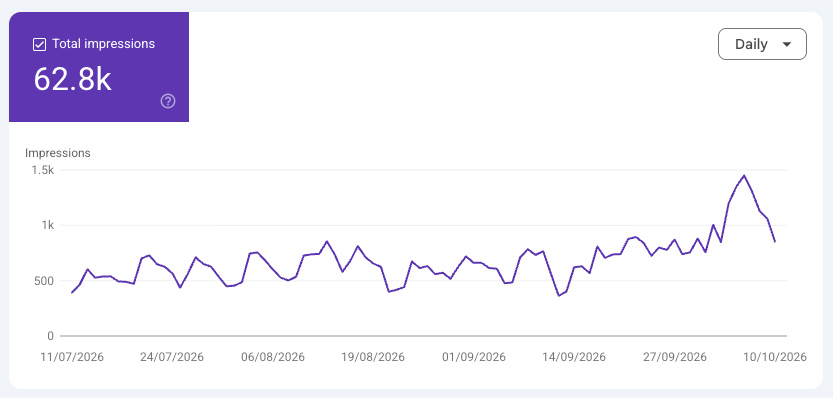
If you checked that daily, you’d go from delighted to worried and back again within a week. Over a month or two, the trend is what tells the real story.
Being shown in an AI answer also isn’t the same as getting a visitor, and a visitor isn’t the same as a customer. So for every client, we judge AI visibility the same way we judge SEO: by whether the enquiries keep coming in.
AI search myths to ignore
The biggest myth is that you need special tricks to appear in AI answers. Google says there’s no special markup, AI text file or hidden optimisation required. Be wary of anyone promising guaranteed ChatGPT placements: nobody controls what AI tools say, so a guarantee is a guess.
- “You need special AI schema.” Google says no. Structured data helps search engines understand a page, but it doesn’t buy you a spot in an AI answer.
- “You need an llms.txt file.” Google says AI-specific text files aren’t needed for its AI features. I’ve covered the wider debate in is llms.txt worth it?
- “We can guarantee you’ll appear in ChatGPT.” Nobody can. Answers change with the wording of a question, the tool and the day.
- “Publish loads of AI-written articles.” Generic content is exactly what AI can already produce, so it gives AI no reason to mention you.
Five things to check this month
Start with the basics AI relies on. Make sure search engines can crawl your site, cover Bing as well as Google, keep your business details consistent, build genuine reviews and mentions, and make your pages say clearly what you do. None of these needs a big budget, and most you can do yourself.
- Check your key pages can be crawled and indexed. Look at the Pages report in Google Search Console, and make sure your robots.txt file (the file that tells search engines where they can go) isn’t blocking anything important by accident.
- Don’t forget Bing. Set up Bing Webmaster Tools and submit your sitemap. Bing powers Microsoft Copilot, and it’s another route to being found.
- Keep your details consistent. Your business name, address, phone number and opening hours should match across your website, your Google Business Profile and directories. Here’s how to set up your Google Business Profile properly.
- Earn genuine reviews and mentions. Reviews help customers and search engines trust you. Here’s why Google reviews matter.
- Say clearly what you do. Each service page should explain what you offer, where, who it’s for and, where you can, what it costs.
Want to go further with SEO for AI search? Our guide on how to appear in AI search results covers the practical steps in more detail.
How to tell if it’s working
Judge it by enquiries, calls and sales, not rankings or AI mentions alone. Use Google Search Console for your search data, including its newer report on AI impressions, and look at the trend every two to four weeks. Daily figures jump around too much to tell you anything useful.
Checking your AI impressions in Search Console
In June 2026, Google introduced generative AI performance reports in Search Console. They show how often your pages appeared in AI Overviews and AI Mode, broken down by page, country, device and date.
They count impressions only. You won’t see clicks or the searches that triggered them, so treat the report as a visibility check rather than a results report.
A few tips from using it with clients:
- Check every two to four weeks. Compare one four-week period with the one before, rather than reacting to a single day.
- Look at which pages appear. If your service pages show up, great. If it’s only old blog posts, that tells you where to focus.
- Pair it with your enquiries. Rising AI impressions with flat enquiries means people are seeing you but not choosing you yet.
You can also ask ChatGPT or Gemini about your type of business now and again, in a logged-out window. Treat the answers as a snapshot, not a score. If you’re keen to handle some of this in-house, here’s which bits of SEO you can do yourself.
Not sure how AI is affecting your visibility?
Book a free 30-minute chat and we’ll take a look at where you stand, in search and in AI answers. No jargon and no hard sell, just an honest view of what’s working and what isn’t.
Prefer to read up first? Have a look at our SEO services.